From Recipe Card to Shared Kitchen Memory
A recipe card can carry family and community knowledge forward. Use a simple weeklong routine to record substitutions, cues, and cooks’ notes.
A recipe card becomes shared kitchen memory when the next cook can tell what changed and why. To keep recipe cards useful across generations, make room for the small decisions a recipe’s ingredient list cannot explain: how ripe the pears should be, what to do when the dough feels dry, or which substitution worked for a neighbor.
You do not need to turn a family recipe into a formal archive. A weeklong routine can help you choose one card, gather what people remember, and leave a clear record for whoever cooks next. Think of the card as a well-used map: each cook can add a landmark without erasing the route.
Why does a recipe card need more than ingredients?
Ingredients and quantities offer a starting point, but they rarely capture the full judgment involved in cooking. A card might say “add flour until ready” without explaining whether the dough should cling to a finger or pull cleanly from the bowl. That cue may live in someone’s hands rather than on paper.
Annotations preserve those cues in a form another person can use. They can also show how a dish changed as ingredients, equipment, or household needs changed. A note such as “use canned tomatoes when garden ones are scarce” records more than a substitution; it shows how the cook kept the dish in reach under different conditions.
Keep the original wording where it carries meaning. Add a dated note beside it instead of silently rewriting the recipe. That way, a new cook can distinguish the old instruction from a later choice.
What can you gather before changing the card?
Choose a recipe people still make, or one they would like to make again. Set the card on a clean table with a pencil, a notebook, and any related recipe pages. If the original is fragile, leave it untouched and work from a photocopy or a faithful transcription.
Ask a cook who knows the dish to describe the moments where judgment matters. Invite them to show or explain, rather than asking only, “What is the recipe?” Useful prompts include:
- What should the mixture look, smell, or feel like before the next step?
- Which ingredients have you replaced, and what did you use instead?
- What equipment or pan do you reach for, and what changes if it is unavailable?
- What part do you adjust for taste, and what do you leave alone?
- Is there a reason a particular person, season, or gathering is linked to this dish?
Record the speaker’s words plainly. If two relatives remember different versions, keep both accounts with their names or relationship to the recipe. A family’s shared memory does not have to mean one version is declared the only correct one.
How can you build the record over one week?
Day one: Select the card and make a clean working copy. Note where it came from, who usually cooks it, and whether the copy reflects the original or a later version.
Day two: Talk with one or two cooks. Write down sensory cues, substitutions, and any steps they tend to skip because they assume everyone knows them. Mark uncertain details as questions rather than filling gaps with guesses.
Day three: Review the notes with the person who supplied them. Ask whether “until it looks right” can be made more observable: perhaps the sauce coats a spoon, or the dough holds its shape when lifted. The aim is not to make every recipe exact; it is to give a new cook a useful signpost.
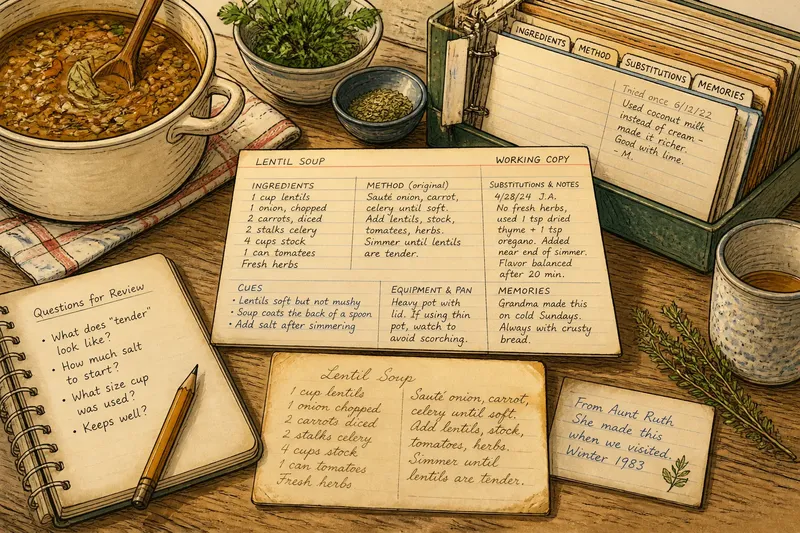
Day four: Cook from the working copy if that suits your plans. Keep a separate page beside the bowl for what you notice. Say you are making a lentil soup whose card calls for fresh herbs, but the market has none. You use dried herbs and write down when you added them, then note whether the flavor was balanced after simmering. The next cook can decide whether to repeat that choice, rather than treating it as an original instruction.
Day five: Ask another cook to read the card and point out any unclear wording. Let them identify questions before you explain the recipe aloud. Their confusion can reveal an unstated assumption, such as whether “a cup” means a teacup or a standard measuring cup.
Day six: Add the confirmed notes to the working copy. Separate ingredients, method, substitutions, and personal memories with clear labels. Use pencil or a removable note if the wording may change; keep the original card free of edits when it has sentimental or archival value.
Day seven: Put the original and the working copy somewhere the cooks can find them. Tell the people who use the recipe where additions belong, so new notes do not end up scattered across unrelated scraps.
How should different cooks’ notes be handled?
Not every annotation needs to become a permanent instruction. A one-time change made because a pantry was bare may be useful history, but it should not be mistaken for the standard method. Mark such notes as “tried once,” “seasonal option,” or “for a smaller batch,” when that distinction helps.
Give each addition a name or initials and a date if the group is comfortable with that. This lets readers ask the right person about a note and gives the recipe a visible thread of contribution. If names are not wanted, a simple “later note” or “community version” can still distinguish additions from the source.
When cooks disagree, preserve the disagreement briefly and clearly. One person may prefer a crisp edge; another may favor a softer center. Recording both preferences can help future cooks choose for their own table without turning taste into an argument about authenticity.
What questions do cooks often ask about recipe cards?
Should I write directly on an old recipe card?
If the card is fragile or meaningful as an original, keep it intact and make a working copy. Add notes to the copy, then store it with the source so the relationship between them stays clear.
How do I record a substitution that changes the flavor?
Name both the original ingredient and the replacement, then note what changed in taste, texture, or timing. Keep the observation specific enough to help the next cook decide whether that tradeoff suits the meal.
What if no one remembers where a recipe came from?
Write down what is known, such as who last cooked it or where the card was kept, and leave the origin uncertain. A blank or question mark is more honest and useful than an invented story.
How can a community kitchen share notes without crowding one card?
Keep a master copy in a shared binder or folder and use a separate page for longer variations. A card can point to that page, while the additions remain easy to read and update.
Where should the recipe live after the week?
Choose a home that matches how people cook: a binder near the kitchen table, a folder in a community kitchen, or a digital copy that cooks can access without handling the original. If you scan a card, keep the image alongside a readable transcription so handwriting and later notes remain available.
Make the record easy to revisit, not precious to the point that nobody touches it. A small space marked “next time” can invite the next cook to note a seasonal change or clarify a confusing cue. Review those additions when the recipe is made again, and keep the ones that help someone else cook with confidence.
That is how a recipe card carries more than instructions. The original cook’s habits remain visible, later cooks can add their own knowledge without overwriting the past, and the next person receives a recipe they can understand and make their own.